Are Long Distance Relationships Bad?
- Timothy
- May 31, 2020
- 3 min read
Updated: Jun 4, 2020
So were are in the midst of COVID -19 days we are all far apart to enforce social distancing, or maybe you are in a Long Distance Relationship (LDR) because of work or other circumstances. We get it! A lot of times we have a negative perception of LDR. This struggle does not mean you should give up nor should it stop you from maintaining your relationship with someone you love! Well here is some good news for ya. Research analysis has found that people who use computer-mediated communication through various media platforms like iMessage have exchanged more self-disclosures and asked more questions than face to face partners. Moreover, analysis has found that computer-mediated communication seems to contain more personal topics exchanged compared to face to face ones. But, of course, we are of course not telling you to only texting once COVID is over!
There are several advantages in using computer-mediated communication like texting when we are in LDRs:
Sending a message keeps the relationship in existence
Lets partner know that he or she is in the mind of the other
Each message is an attempt to openness
The purpose of each message can be analyzed to determine its maintenance.
Partners reported greater love and closeness to their partners, and less relationship insecurity than those who did not.
Keep in mind. As for verbal face to face communication, there are also issues that can happen no matter which medium you are communicating through so below are something to keep in mind. Here are some examples to help you identify certain red flags that could happen between you and your partner no matter if it's verbal or non-verbal. In the end remember that communication skills apply for all partners, no matter if you are physically together or living halfway across the world!
Below are a few examples of common communication issues that can arise below:
The Situation
A huge argument arose, partner so happens to have an urgent meeting tomorrow.

What Went Wrong? - Mind Reading
Mind reading occurs when people assume that they understand their partners’ thoughts, feelings, and opinions without asking.
All intimate couples mindread to some extent, but distressed couples do so in critical and hostile ways; they tend to perceive unpleasant motives where neutral or positive ones actually exist.
Correct Yourself! - Perception Checking
Perception checking is used to assess the accuracy of their inferences about a partner’s feelings by asking the partner for clarification.
Listeners who paraphrase and check their perceptions make an active effort to understand their partners, and that care and consideration are usually much appreciated.
The Situation
An argument on toilet seats being left up arises when in the midst of rush hour to work.

What Went Wrong? - Criticism
Criticism is when a partner attacks a partner’s personality or character instead of identifying a specific behaviour that is causing concern.
We all criticized someone at some point in our lives. We feel ya and that is okay! Generally criticizing someone does not help you nor your partner in heated situations as the person would likely act back and accuse you. Creating a loose - loose situation.
Correct Yourself! - XYZ Statements
Instead, use this template where you can use a behaviour description instead of criticizing your partner. - “When you do X in situation Y, I feel Z"
When using XYZ statements it allows you to have a thoughtful apologetic response from your partner! Win-Win Eh?
The Situation
Having an argument where one does not agree with each other
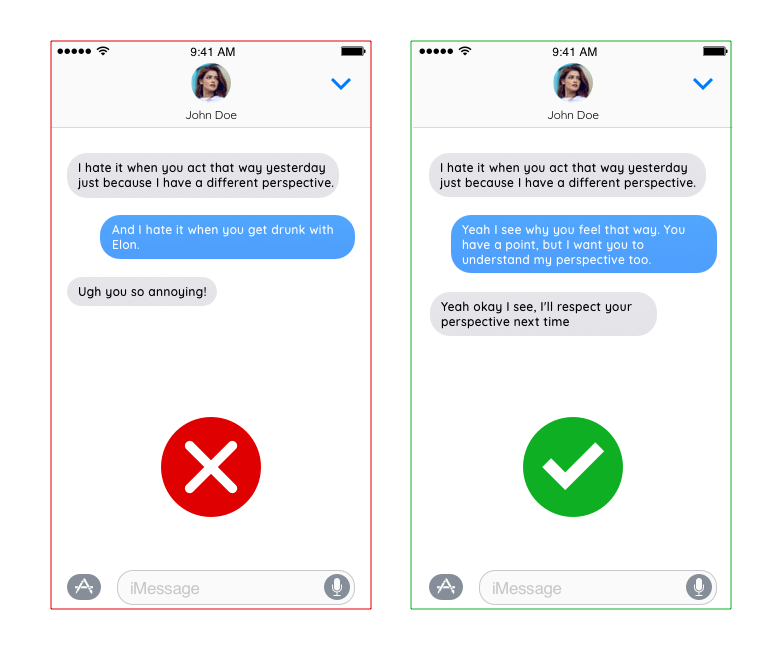
What Went Wrong? - Cross-Complaining
How you react is just as important! Here is a cross complaining issue where we fail to acknowledge other's concerns. This would lead you and your partner just complaining at each other and going nowhere with the conversation.
Correct Yourself! - Validation
You can use validation to acknowledge your partner's concerns, this does not require you to agree with your partner. You can communicate appropriately with respect and recognition of a partner’s point of view without agreeing with it.
Extra Resources That You Might Find interesting!
References
Canary, D. J., Dainton, M., & Taylor & Francis eBooks A-Z. (2003;2002;). Maintaining relationships through communication: Relational, contextual, and cultural variations. Mahwah, N.J: Lawrence Erlbaum Associates. doi:10.4324/9781410606990


Comments